
Visa Document Preparation Tips Australia
Visa Document Preparation Tips Australia
Good document preparation can make a complicated migration process much easier to understand and manage. When your records are organised, readable and consistent, it becomes easier to see what information is available, what may still be needed and where questions require closer attention.
Why Supporting Evidence Deserves Early Attention
Australian visa applications can involve different types of supporting evidence depending on the visa, the applicant’s circumstances and the information being assessed.
There is no single document list that applies to every applicant. Identity records, relationship evidence, employment information, education documents, financial records and other supporting material may be relevant in different situations.
This is why collecting everything at the last minute can create unnecessary confusion.
Starting early gives you time to locate missing records, check details and understand what each document actually demonstrates. It also allows you to identify inconsistencies before they become harder to explain.
For people preparing an Australian migration matter in Clyde North, Cranbourne, Berwick or elsewhere in South-East Melbourne, good organisation can make discussions with a migration professional more productive from the beginning.
Think About What Each Document Shows
One useful approach to supporting evidence for a visa application is to think beyond the document name.
Ask yourself what the document demonstrates.
A passport may establish identity and travel details. An employment record may provide information about work history. A certificate may support an educational claim. Other records may help establish dates, relationships, residence or personal circumstances.
This way of thinking can make visa paperwork organisation much clearer.
Instead of creating one large folder containing every document you have ever received, organise records according to the information they support. This makes it easier to review what you already have and identify possible gaps.
Create Clear Document Categories
Simple categories can make a large collection of files much easier to manage.
Depending on your circumstances, you might organise documents under headings such as:
- Identity and personal records
- Travel history
- Employment
- Education and qualifications
- Relationships and family
- Financial information
- Previous visa or immigration records
- Other supporting evidence
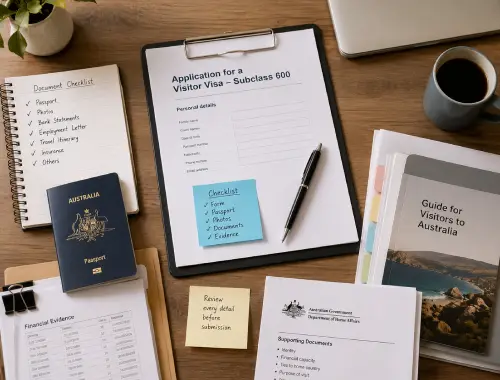
These categories are organisational tools only. They do not mean every visa application requires documents from every category.
The actual evidence required should always be checked against the relevant application requirements and your individual circumstances.
Check That Important Details Are Consistent
Document consistency for immigration applications is an important part of preparation.
Names, dates, addresses, employment periods and other personal information may appear across several different records. Before relying on those documents, compare important details carefully.
For example, if your name appears differently across documents, there may be a legitimate explanation such as a name change, spelling variation or different naming convention. The important point is to notice the difference rather than discovering it unexpectedly much later.
The same principle applies to dates and timelines.
Create a simple chronological record of important events if your circumstances involve several periods of study, employment, residence or travel. A timeline can help you understand how different pieces of evidence relate to one another.
Good preparation is not about changing information so everything looks identical. It is about identifying differences and making sure the information you provide is accurate.
Make Digital Records Easy to Review
Many migration-related processes involve electronic documents, so file organisation matters as much as paper organisation.
Avoid filenames such as:
scan001.pdf
or:
document-final-new2.pdf
Use descriptive names that tell you what the file contains.
For example:
Passport-Applicant-Name.pdf
or:
Employment-Letter-Company-Name.pdf
A consistent naming system makes documents easier to locate and reduces the chance of confusing similar files.
Check Readability Before Using a File
Open every scanned document and review it yourself.
Check that:
- all relevant pages are included
- text can be read clearly
- important information has not been cut off
- the file opens correctly
- pages are in a sensible order
A document may exist on your computer without being useful if important sections are blurry, missing or difficult to read.
Where documents are not in English, translation requirements may also apply. These requirements should be checked for the relevant application rather than assumed.
Keep Your Own Copies and Records
Good visa application record keeping continues after documents have been prepared.
Keep your own organised copies of the information and evidence you provide. Australian immigration processes can extend over time, and being able to refer back to the exact records you used can be valuable if questions arise later.
It is also sensible to keep copies of important correspondence and note significant dates.
If your circumstances change while a matter is progressing, those changes may also need attention. Maintaining an orderly record makes it easier to understand what information was previously provided and what has changed since then.
Avoid Treating a Checklist as the Whole Application
A document checklist is useful, but good preparation involves more than collecting files and ticking boxes.
Evidence needs to relate logically to the information in the application. A large volume of documents does not automatically make an application clearer.
Relevance matters.
Before including a document, understand why it is being provided and what information it supports. If you are unsure about the significance of a particular record, professional guidance may help determine what deserves closer consideration.
The goal is not to create the biggest possible document collection. It is to prepare accurate, relevant and understandable information appropriate to your circumstances.
Preparation Creates Better Questions
One of the biggest benefits of organising evidence early is that it helps you identify the questions you actually need answered.
You may discover that a document is missing, two records contain different information, part of your history requires explanation or you are uncertain about what evidence is appropriate.
Those discoveries are useful.
They allow you to raise specific questions rather than beginning a professional conversation with an unorganised collection of files and no clear picture of what you have.
Start With Clearer Information
Strong preparation cannot determine whether a particular Australian migration pathway is suitable for you, and document requirements can differ substantially between applications. What it can do is give you a clearer foundation for understanding your circumstances and discussing the next step.
Visa Route Migration assists people in Clyde North, across South-East Melbourne and further afield with Australian migration matters through a personalised professional approach. If you would like help understanding your circumstances and what your next step may involve, contact Visa Route Migration to arrange a free initial consultation.